







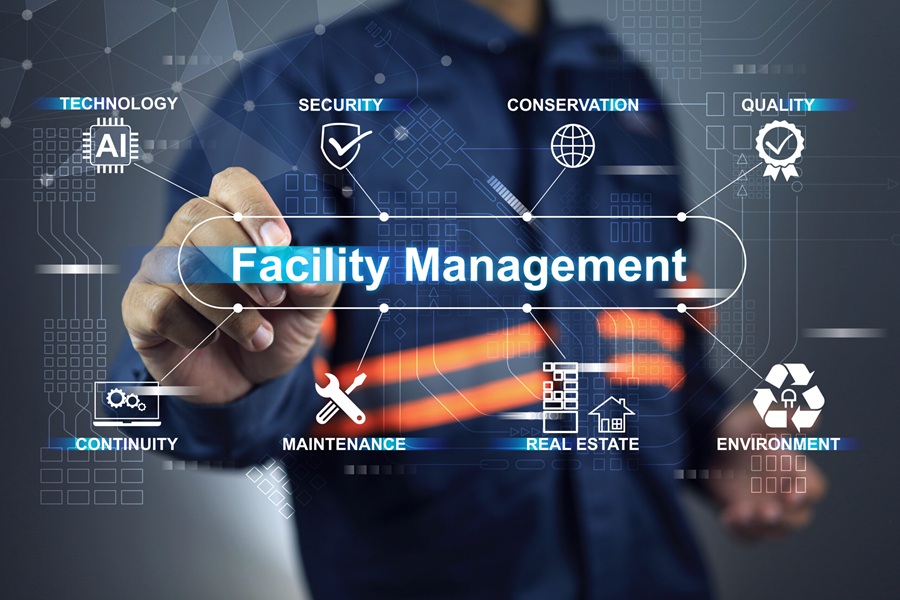
Facility management tends not to make headlines when it is done properly. The buildings function, the systems function, and everything flows evenly for everyone who works in them. But what sustains this regular function is a highly organized and much broader discipline than it was a decade ago.
Consequently, rather than involving problem-solving when an organization grows in size, manages multiple facilities, or operates in environments with increased safety and sustainability norms, FM becomes a tool of planning, coordination, and control. This description aims to facilitate the comprehension of this subject, define the concepts, and provide practical aspects concerning this matter in the following article.
What Is Facility Management
Facility management refers to the strategic coordination of all structures, infrastructures, and other physical assets related to an enterprise’s core operations. It integrates people, places, processes, and technology into one entity that ensures continuity and efficiency.
Contrary to stand-alone maintenance or cleaning solutions, facility management concerns the entire life cycle of the building in question. It impacts the building during the designing phase, the maintenance phase of the building’s properties, space utilization in the building, as well as risk control in the building.
What It Covers in Real Terms
Facility management includes both technical and service-oriented responsibilities. On the technical side, this involves building systems, utilities, energy usage, and asset maintenance. On the service side, it covers cleaning, security, workplace services, and space coordination.
In modern organizations, facility management also contributes to compliance, cost governance, sustainability targets, and employee wellbeing.
How Facility Management Works in Practice
Facility management operates on the basis of formalized procedures, not just reactive response. There are emergencies, but a day-to-day functioning relies upon planning, schedules, and performance tracking.
Facilities teams use a set of predefined workflows to manage maintenance, coordinate vendors, monitor assets, and document compliance activities. This leads to fewer surprises and improved reliability in the long run.
Shifting from Reactive to Planned Operations
Historically, many organizations only took care of facility issues after these failures had taken place. Such a reactive model is a costly one, which reduces asset life and introduces safety risks.
The philosophy of today’s facility management is one of prevention. Assets are watched, maintenance is scheduled, and issues are fixed before they cause an operational disruption. As this type of approach continues to stabilize over time, it also provides greater predictability of costs.
Facility Management Services Explained
Facility management services are typically organized around function rather than department. While delivery models vary, most organizations rely on a core set of services that keep facilities operational.
These services include:
- Building and equipment maintenance
- Cleaning, security, and workplace services
- Energy and utilities management
- Space planning and utilization
- Health, safety, and regulatory compliance
Some organizations manage these services internally, while others rely on external facility management services or integrated delivery models.
Integrated Facility Management
Integrated facility management brings multiple services related to the facilities under one management structure. Instead of having separate contracts for maintenance, cleaning, security, and utilities, the organization centralizes oversight and reporting.
The model allows for better coordination and less duplication. It also makes performance measurement easier, as service level and cost information are tracked within a single framework. Integrated Facility Management This model works very well in organizations with more than one building or even with industrial sites.
With Viva Sync, this is generally supported by integrated models that tie facilities operations to processes such as finance, compliance, and vendor governance, not being treated as a standalone function.
Facility Management Systems as an Operational Foundation
As facilities increase in number and sophistication, manual coordination becomes increasingly hard to maintain. The use of spreadsheets, email trails, and disjointed applications creates blind spots and makes it difficult to make decisions across multiple facilities. The role of facility management software in this scenario is to ensure that data and responsibilities related to facilities are organized in one location.
What Is a Facility Management System
A facility management system allows for the consolidation of information on a particular operation regarding assets, repairs, service requests, contracts, and compliance. As opposed to current practices that involve the use of multiple tools, a facilities management system allows for a single platform where the operation processes are monitored.
On a fundamental level, it is capable of managing work orders, asset, and service history, thereby enabling traceable processing of routine jobs. When at an advanced stage, it can facilitate planning, forecasting, and analysis in terms of relating operational data to cost, usage, and risk metrics. It helps organizations in dealing with facilities planning from a purely reactive maintenance perspective.
Facility Management Software and Automation
Contemporary facility management computer programs rely on cloud technology that enables teams to gain insights from data across multiple facilities using various devices independent of facility infrastructure. Automation remains an important consideration in this case where it performs tasks such as preventive maintenance scheduling, assigning work orders, and notifying vendors.
As manual coordination is minimized by automation, it enables greater efficiency and speed in response. The facilities teams, in turn, have deeper capabilities in activities like optimization and long-term planning.
Computer Aided Facility Management (CAFM)
Computer-Aided Facility Management, or CAFM, is concerned with the physical and territorial nature of facilities and facilities management. CAFM is a technology that interlinks floor plans, facilities, and maintenance schedules within a graphical context.
This helpsFM understand space usage, location of assets, and maintenance operations impact on specific areas. The application of CAFM is beneficial in office buildings, campuses, hospitals, and industrial plants because these have complex spaces.
Facility Asset Management and Lifecycle Planning
Facility asset management is the process of managing the physical assets from the time they are in place to their operation, maintenance, and even replacement.
HVAC systems, electrical, elevators, and safety equipment are all long-term investments. Monitoring their condition and performance supports the work of facilities teams as they plan for asset life extension and try to prevent unexpected failures.
In this way, lifecycle data also supports capital planning by offering an organization the ability to budget replacements rather than react to breakdowns.
Technology Trends in Facility Management
Technology in facility management continues to get more advanced as buildings get smarter and, thus, connected. Sensors, analytics, and automation increasingly support decision-making functions in facilities.
The current trend includes predictive maintenance based on usage data, energy management platforms, mobile tools for field teams, and analytics dashboards linking cost, performance, and asset condition.
Organizations that implement these technologies often realize greater efficiency, safety, and transparency without added operational complexity when systems are implemented with appropriate governance in place.
Sustainability
Sustainable facility management is based on minimizing environmental impact while maintaining operational effectiveness. Facilities are a leading source of energy consumption, so facilities are at the forefront of any sustainability initiative.
Energy optimization, waste management, heating, ventilation, and air conditioning optimization, and effective space management help in sustainability objectives. Usually, they tend to reduce operating expenses as well. There is a link now between sustainability and how a company is regulated, and it is no longer an activity that is opted for.
Safety, Compliance, and Risk Control
Facility Management: Facility management has a big role in workplace health and safety. Buildings have to provide facilities for health and safety, fire regulations, accessibility, and sector-specific requirements.
The facilities departments coordinate the inspections and handling of the paperwork associated with corrective actions. Audit trails can be easily followed for all matters related to company compliance. Such an approach mitigates risks and leads to business continuity.
Facility Management in a Global and Multi-Site Context
Facility management can become intricate for organizations that manage several facilities located in different locations, regions, or countries. The varying regulations, norms of buildings, climate, and expectations of these facilities can create a difference in managing these facilities.
In a multi-site situation, consistency is one of the greatest issues. For example, a certain process could work well in one facility but it could not be implemented in another facility in a similar way. A good facility management practice should find a proper balance between standardization and localization and allow a company to execute its policy at a localized facility.
Centralized monitoring is also a highly critical component in this regard. By developing a common monitoring structure for reporting, this ensures that the whole organization is able to view their activities in a centralized way while at the same time making sure that localized employees are operating in a planned way.
Viva Sync helps in dealing with such complexities for organizations by ensuring that management of various functions that are conducted within an organization is well synchronized, ensuring that control and performance measurement stay the same even when the location changes.
Cost Control Through Effective Facility Management
Facility management has a direct impact on costs of operations. There is a reduced need for emergency maintenance with planned maintenance. Energy consumption is also reduced by energy monitoring. Unwanted use of floor space is decreased with space optimization.
When the data related to facilities is centralized and then analyzed, organizations are able to get a clear view of the cost drivers. As time passes, improvements in efficiencies will have a compounding effect.
Implementing facility management effectively
Effective facility management implementation starts with assessment. Organisations must have an understanding of their own assets, service requirements, and operating priorities.
Following this, systems are identified, processes are documented, and persons responsible are assigned. Training is done to ensure that tools are used uniformly amongst employees and service providers.
Those implementations that incorporate an organized approach to implementation, rather than rushing to launch, seem to reach more stable results. This particular approach to implementation has been seen to be specifically applied in cases of Viva Sync, particularly in relation to facility management being enabled in overall operation governance.
Common Challenges in Facility Management
Challenges in facility management often come one after the other. In organizations where facility expansion is organically based and not necessarily strategically planned, facility management challenges will come one after the other. The data fragmentation problem is one of the most prevalent problems experienced. The data related to facilities, including maintenance and service contracts, is often siloed.
Reactive maintenance is also a common issue that can be encountered. When there is a lack of asset data and preventive maintenance, the facilities teams are left with no other option but to react to breakdowns rather than preventing them. In facilities management, there are many assets that require integration with other assets for proper management of the facilities of any organization.
In order to overcome these challenges, it is not necessary to make any overnight transformations. By integrating data, responsibilities, and structured governance, it becomes possible to make progress. Along with following facility management technology, it becomes possible to achieve progress, no matter how small it might be, in terms of efficiency, reliability, and cost-effectiveness.
The Future of Facility Management
The facility management operations are gradually migrating to deeper levels of integration and smarter use of data. Automation is progressively taking care of mundane tasks like work order generation, condition checking, and basic reporting, leaving facilities professionals with more time to focus on planning instead of reacting.
The increased connectivity of buildings through sensors is giving facility managers real-time information about asset performance, energy usage, and space utilization. On the other hand, the increased desire for sustainability as well as governmental pressure is pulling the function of facility management towards the realm of strategic decision-making. The function of facilities is increasingly becoming a source of knowledge based on which long-term decisions are made.
Conclusion
The field of facility management has emerged as a systematic process that impacts cost control, safety, sustainability, and reliability. The function of facility management is not at the back but at the root of any organization.
Through planning, technology, and an integrated service model, facilities can be proactively maintained, compared to a purely reactive approach in the past. With rising levels of complexity in business, facilities management is set to play an important role in stability and growth.
FAQ: Facility Management
❓ What is facility management used for?
Facility management ensures that buildings, assets, and workplace services operate efficiently, safely, and in compliance with regulations. It supports uninterrupted business operations.
❓ What is a facility management system?
A facility management system centralizes data related to assets, maintenance, space, and services, enabling structured planning and better control.
❓ How does CAFM differ from facility management software?
CAFM focuses on spatial and asset visualization, while broader facility management software includes workflows, vendors, and analytics.
❓ What is integrated facility management?
Integrated facility management combines multiple facility services under one coordinated structure, improving efficiency and accountability.
❓ Why is sustainable facility management important?
Sustainable facility management reduces environmental impact, lowers operating costs, and supports regulatory and ESG requirements.